
The Adoption Gap: Why Enterprise Software Fails
Quick Answer
The adoption gap is the difference between the software a company buys and the software its team actually uses typically less than 30% of paid capability. It is the leading reason enterprise software projects fail, and it is caused by poor fit and absent change management, not bad code. The fix is a workflow-first build plus an on-site adoption team, measured by one number: the 6-month utilisation rate. Buyers who demand that metric before signing and partners who track it consistently get more from their software than buyers who compare features and price. By Mr. Sumeet Katariya, CEO Accucia Softwares
Key Takeaways
- Most teams use under 30% of the software they pay for the adoption gap.
- Software fails at adoption, not code; the model is rarely the problem.
- The fix is workflow-first delivery plus an on-site team that stays through go-live.
- Demand the 6-month utilisation rate and write adoption into the contract.
- This reframes the buying decision from "features" to "will it be used?"
What is the adoption gap?
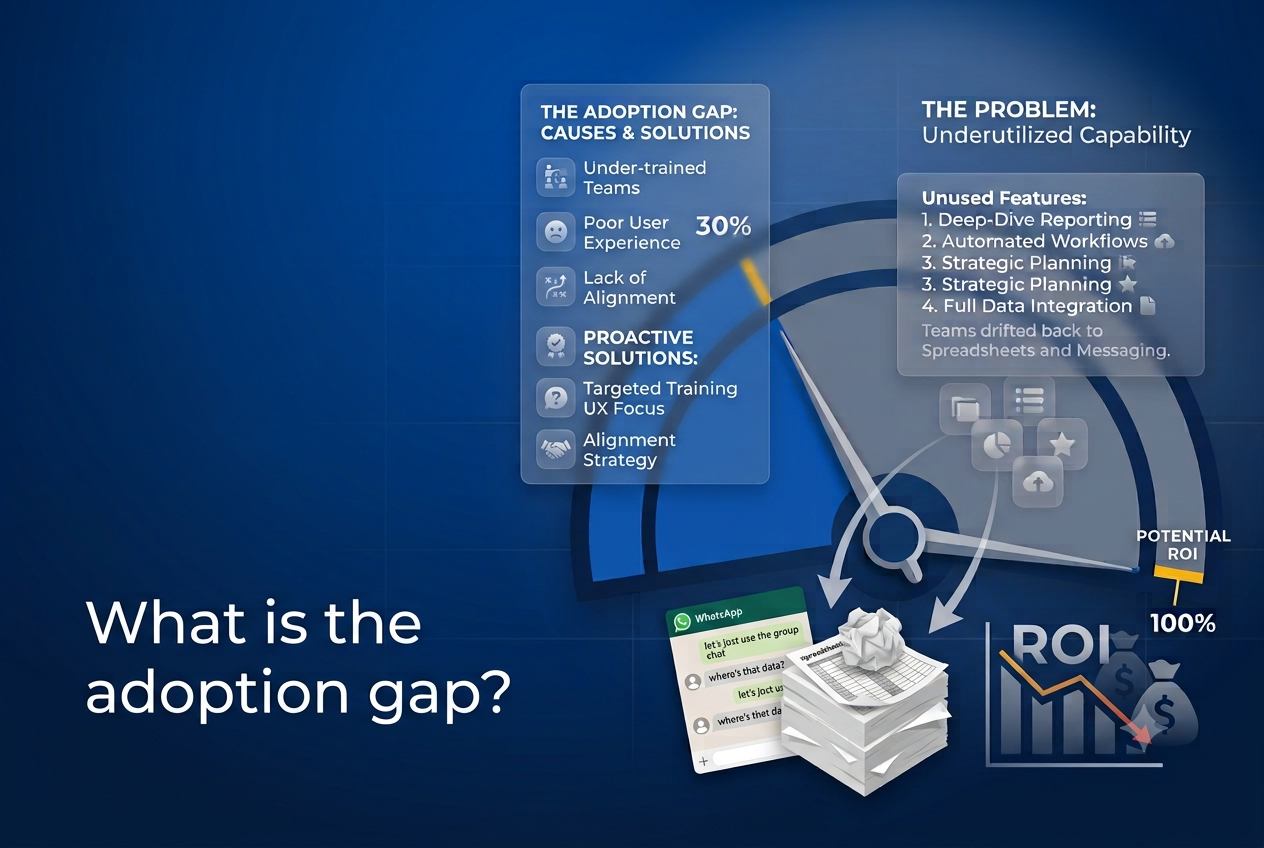
The adoption gap is simple to state and expensive to ignore: companies pay for software, and their teams use a fraction of it. Industry data consistently puts active usage below 30% of purchased capability. The build works. The login works. And yet, six months later, the team has quietly drifted back to spreadsheets, WhatsApp threads and the way they did things before.
That gap between bought and used is where most enterprise software ROI quietly dies.
The 30% problem
Why does it happen so reliably? Because most software is sold and delivered as a product, when adoption is actually a behaviour change. A new system asks people to give up habits that work for them today in exchange for a promise of something better later. Without help, friction wins. People are rational: they route around anything that slows them down.
The result is a paradox. The software isn't broken. The project isn't late. But the value never shows up, because the value was always going to come from usage and nobody owned usage.
The 5 real causes of failed adoption
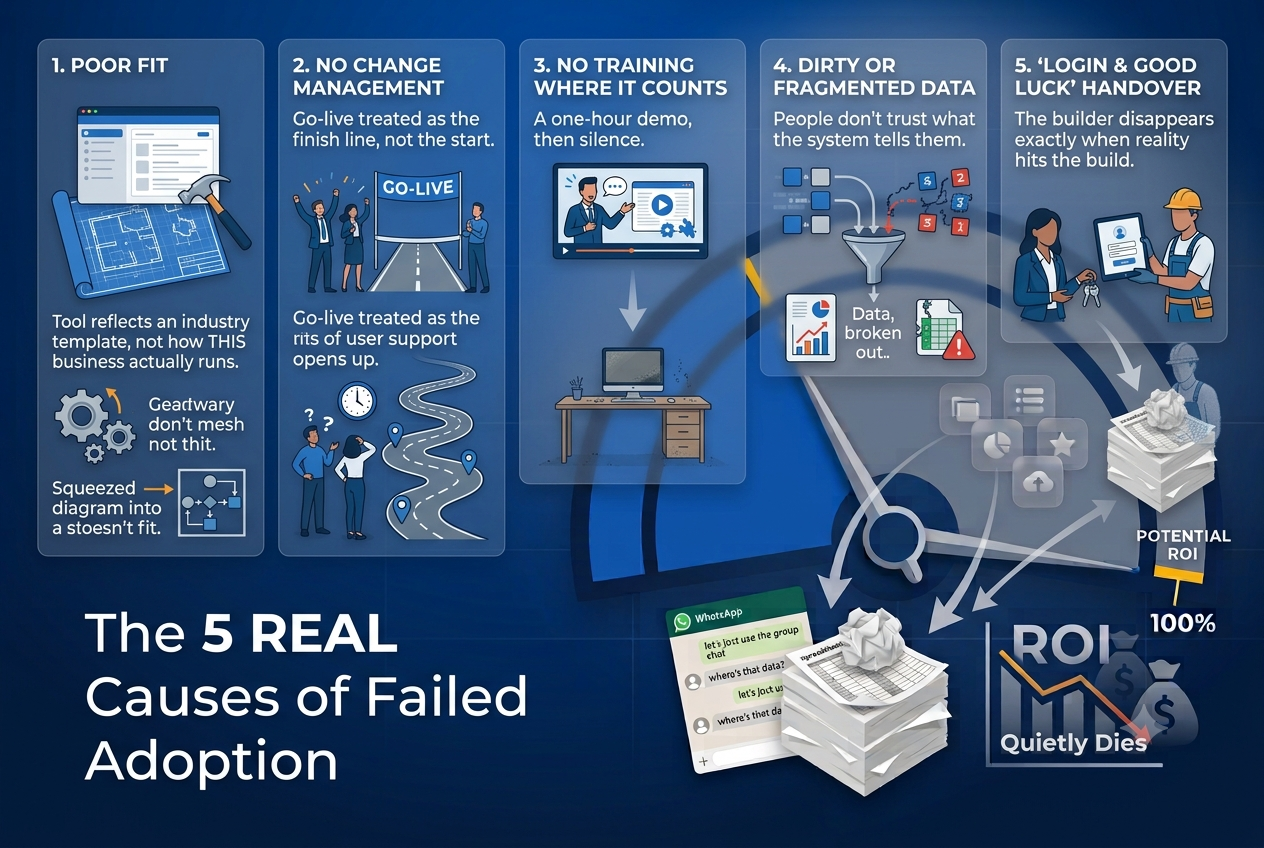
- Poor fit — the tool reflects an industry template, not how this business actually runs.
- No change management — go-live is treated as the finish line, not the start.
- No training where it counts — a one-hour demo, then silence.
- Dirty or fragmented data — people don't trust what the system tells them.
- The "login and good luck" handover — the builder disappears exactly when reality hits the build.
Teams are usually blamed for resistance to change. Across our delivery record, the reasons are far more rational than that, and every one of them is the vendor's fault before it is the user's.
The system was built at the business, not around it. Requirements were gathered in a conference room from people describing how work is supposed to happen. The actual workflow, with its exceptions and side channels and field realities, was never watched. The result fits the org chart and misses the day. The most useful thing a discovery phase produces is the finding that contradicts the briefing.
It made the day longer. If recording a job takes eleven clicks where the old register took one line, the register wins by Friday. Software that adds steps without removing any is asking users to fund it with their evenings. They decline, politely and permanently.
Nobody trusted the data. One wrong stock figure in week two is enough. Users start keeping a private sheet as a check, the sheet becomes the source, and the system becomes the place you copy the sheet into. Data quality is an adoption topic, not an IT hygiene topic.
Nobody stayed to fix version one. Every first release gets something wrong. That is normal and survivable. What is not survivable is nobody being there when it surfaces. Rough edges become permanent, workarounds harden into process, and within a quarter the system is the thing people route around. We covered why this repeats so predictably in Indian IT engagements in why Indian IT firms will not talk about what happens after month two.
The fix: workflow-first build + on-site adoption
The structural fix has two halves.
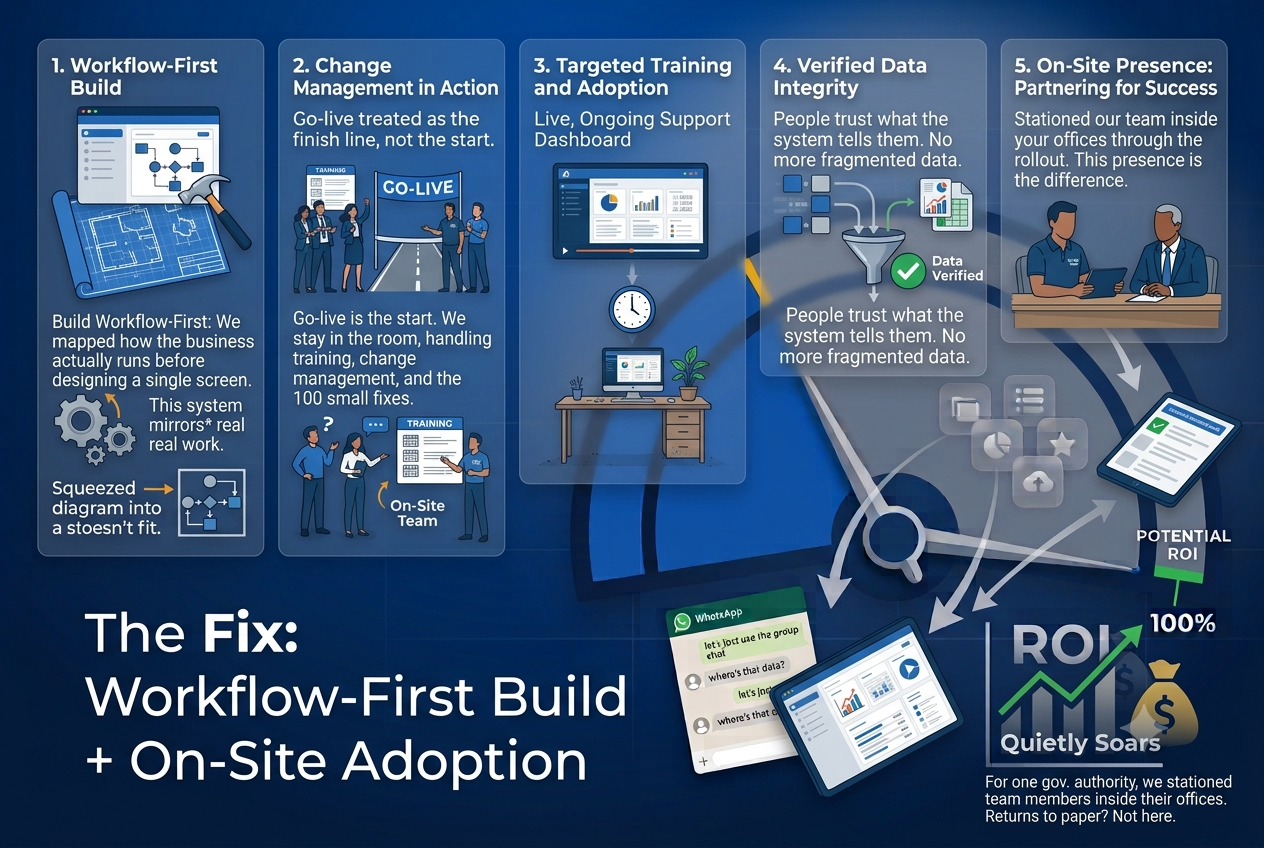
First, build workflow-first. Map how the business actually runs before designing a single screen. Software that mirrors real work gets adopted; software that asks people to change how they work to suit it does not.
Second, stay on-site through go-live. Put people in the room handling training, change management and the hundred small fixes that decide whether a system sticks. For one government authority, that meant stationing two of our team inside their offices through the rollout. That presence is the difference between a system that becomes the way work is done and one that returns to paper in three months.
The one-hour training myth
One session, one PDF, one line about reaching out with questions. That is the training budget on most implementations, and it is the single cheapest place where projects are lost.
Habits do not form in an hour. In an hour people can be shown a system. They cannot be moved off a routine they have run for four years. Three weeks after go-live the only confident users are the two who were always going to be fine. A month later even they have found a shortcut.
Prosci's research across more than 2,600 change practitioners puts a number on the alternative. Projects with excellent change management met or exceeded objectives 88% of the time. With poor change management, 13%. That is roughly seven times the odds, bought with training rounds and support rather than better code.
Stage training against the adoption curve, not the project plan. One session before go-live for orientation. One in week two, when the questions are real rather than theoretical. One in week six for the parts nobody has opened yet, because that is where the unused 70% is hiding.
The metric to demand: 6-month utilisation rate
If you take one thing from this article, take this: stop evaluating vendors on features and certifications. Evaluate them on the 6-month utilisation rate of their last three deployments. That single number predicts success better than any feature list and most vendors won't quote it, because most don't track it. A partner who optimises for adoption knows their number. A vendor who optimises for delivery doesn't.
How to write adoption into your contract
Make adoption a deliverable, not a hope:
- Define a target utilisation rate at 90 and 180 days.
- Specify who is on-site, and for how long, after go-live.
- Tie a portion of payment or sign-off to usage, not just delivery.
- Require a plan for the day a key user leaves.
When adoption is in the contract, everyone optimises for it from day one.
A proof point
A large Indian pharmaceutical company was drowning in 30,000+ documents nobody could find. Instead of selling them a new system to learn, we embedded an AI assistant inside the app they already used zero new tool, zero retraining friction. Result: 75% less time searching, 95% accuracy, eight-month payback. The technology mattered, but the reason it worked was the same reason most projects fail or succeed: it was built for adoption.
What closing the gap actually takes
The fixes are unglamorous, which is exactly why they are rare.
1. Study the work, not the org chart. Sit with each department and map how work actually moves, including the exceptions leadership does not know about. If a discovery document could have been written without visiting the site, it is not a discovery document.
2. Remove more steps than you add. Every screen must make somebody's day shorter. A workflow that cannot pass that test is not ready to ship, whatever it looks like in the review meeting.
3. Train in rounds and support on the ground. Where the deployment warrants it, put people on site. For a government organisation in Maharashtra we kept two full-time team members embedded with the client. Adoption held across 10 to 15 projects and multiple officer transfers, which is the harder test, because in government the person you trained in March is often not the person using the system in September.
4. Stay and iterate until it holds. Usage data shows exactly where the system fights the work. The weeks after go-live, the ones most vendors skip, are where adoption is actually won or lost.
Week 1 to 2
On-site or on-call presence, daily issue triage, fast fixes to the top three friction points
The first workaround becoming permanent
Week 3 to 4
Second training round on real cases, usage review by department
Quiet drop-off in the departments nobody is watching
Week 5 to 8
Module by module utilisation review, config changes, second round of process mapping
The unused 70% settling in as normal
Month 3 to 6
Utilisation reported as a number, not a feeling, with owners named per module
The system surviving on paper while the work moves back to spreadsheets
If you want one question to put to every shortlisted vendor, ask for their six month utilisation rate on their last three deployments. We set out why that single number predicts more than any feature grid in the one metric every CIO should demand before signing.
Frequently Asked Questions
What is a good software utilisation rate?
Aim for 70%+ active use of core features at six months. Anything near 30% means you're inside the adoption gap.
How do I measure software adoption?
Track active users and core-feature usage against the capability you licensed. The gap between the two is your adoption gap.
Whose responsibility is adoption — ours or the vendor's?
Both — but a real partner shares the responsibility by staying on-site until your team is genuinely using the system, and by measuring it.
Why do AI projects fail at the same rate as other software?
Same reason: adoption. AI added to a fragmented stack with no clean process underneath amplifies the chaos. Fix the workflow first, then add intelligence.
Build Software People Actually Use.