
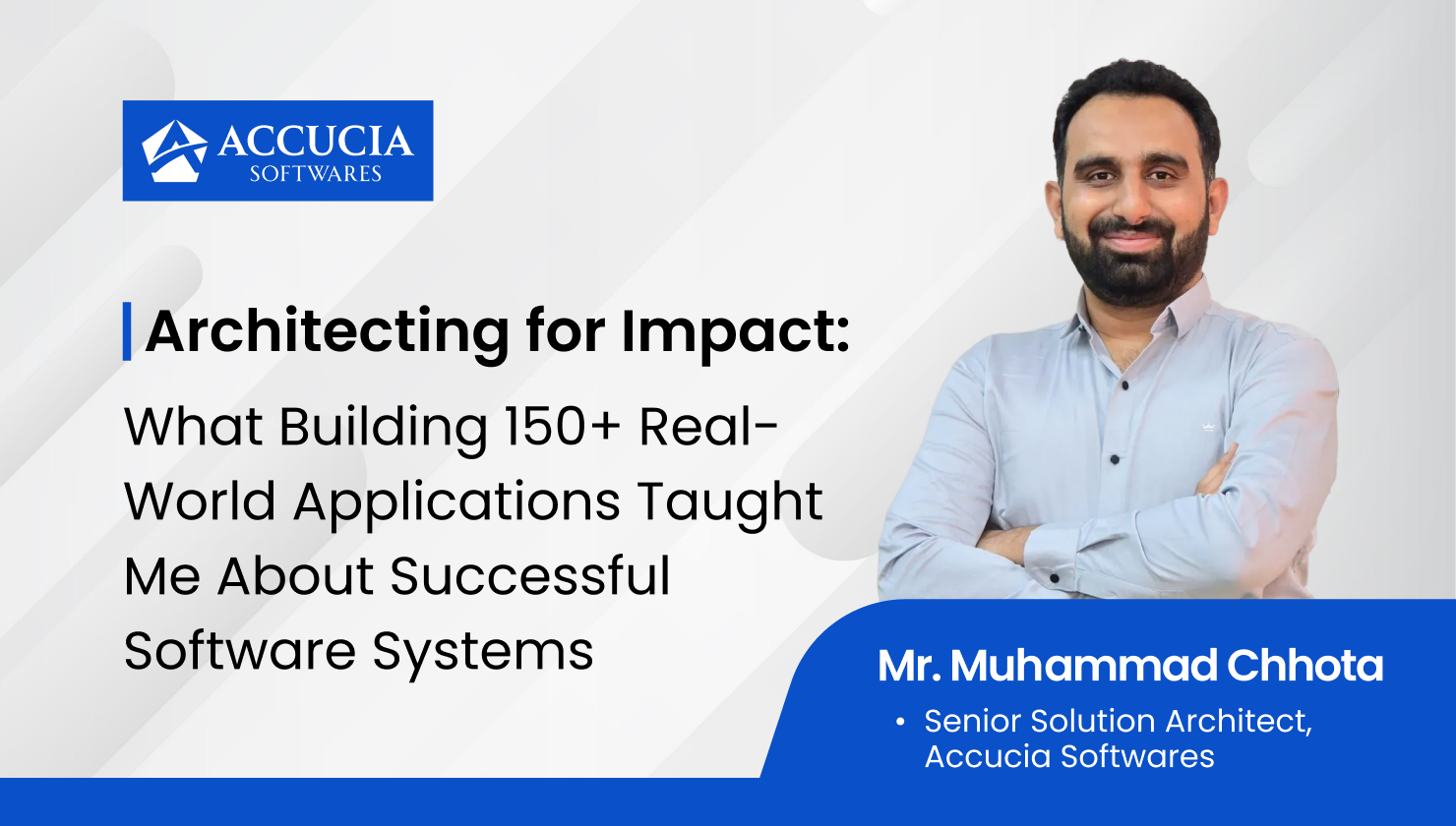
Architecting for Impact: What Building 150+ Real-World Applications Taught Me About Successful Software Systems
Muhammad ChhotaSenior Solution Architect, Accucia Softwares
Over the last 10+ years, my role in software development has evolved significantly—from a junior developer, to a senior developer, and eventually to a senior solution architect responsible for designing systems that operate at scale and directly support business growth.
During this journey, I have personally contributed to and architected 150+ real-world applications, many of which are used daily by thousands—and in some cases, millions—of users. These systems span high-traffic mobile applications, enterprise platforms, and operational systems where reliability, scalability, and long-term maintainability are not optional.
Through this experience, one belief has become central to how I approach software architecture
Technology alone does not create successful systems. Architecture succeeds only when it aligns with business goals and real user needs
This article reflects my personal learnings as a solution architect—lessons shaped by real production systems, real failures, and real growth.
From Writing Code to Designing Outcomes
Early in my career, my focus was primarily technical—writing clean code, implementing features, and delivering functionality. As I progressed, I began to realize that well-written code does not automatically translate into successful software.
The transition to architecture required a mindset shift
- From features → to systems
- From implementation → to outcomes
- From short-term delivery → to long-term sustainability
Today, my responsibility as a solution architect is not just to ensure that systems work—but that they continue to work as the business grows.
Architecture Must Be Driven by Business, Not Trends
One of the strongest patterns I have observed across startups and enterprises is the tendency to rush architectural decisions—often driven by timelines, trends, or assumptions.
In my experience, architecture should never start with questions like:
- “Which framework should we use?”
- “Should we use microservices?”
Instead, it must begin with:
- What problem are we solving for the business?
- What pain point are we removing for the user?
- How do we expect this system to grow?
Only after answering these questions should technical decisions be made. This principle has guided every major system I have architected at Accucia.
Case Study: Scaling AdBanao Through User-Centric Architecture
A defining experience in my career was working on AdBanao, a mobile application that eventually crossed 5 million downloads.
When development started, the expectation was not massive scale. The architecture was intentionally kept simple but structured—focused on clarity, modularity, and future flexibility.
As the product evolved, we noticed something critical
users deeply connected with specific features that addressed their core pain points.
Once we identified and refined these features, adoption increased rapidly—far beyond initial expectations. This sudden growth brought:
- High traffic volumes
- Increased backend load
- New performance and scalability challenges
Because the system was architected with growth in mind—even without over-engineering—we were able to:
- Scale infrastructure incrementally
- Optimize performance without major rewrites
- Continue feature development without destabilizing the system
The success of AdBanao was not due to complex architecture—it was due to understanding users first and allowing the system to evolve with them.
Enterprise Learning: Building Elevator Plus for Operational Reliability
Another significant example is Elevator Plus, an enterprise platform used by 100+ elevator companies to manage critical operational workflows.
In enterprise systems like this:
- Downtime directly impacts business operations
- Data accuracy is essential
- Security and access control are fundamental
- Predictable scalability matters more than experimentation
Architecting Elevator Plus reinforced one of my strongest beliefs
Over-engineering is a bigger risk than under-engineering—but ignoring scalability and security is a critical mistake.
Enterprise platforms demand architectural discipline—clear boundaries, stable data models, and systems that teams can rely on for years, not months.
Common Mistakes I See Repeatedly
Across industries, I consistently see two architectural mistakes:
1. Rushing Decisions Without Understanding Long-Term Impact
Speed is important—but unvalidated architectural choices often lead to costly rework once the system gains traction.
2. Treating Scalability and Security as “Later Problems”
These are foundational concerns. Retrofitting them later is far more expensive than designing for them early.
Good architecture does not slow down growth—it protects it.
My Architectural Philosophy Today
After years of building and reviewing systems at scale, a few principles guide my work:
- Architecture must support business outcomes
- Simplicity enables scalability
- Systems should grow with user behavior, not assumptions
- Security and reliability are non-negotiable
- Understanding the business is as important as understanding the code
These principles shape how I approach every system I design at Accucia and how I mentor teams building long-term products.
Closing Perspective
Titles and technologies change, but the responsibility of a solution architect remains the same
to design systems that last, adapt, and create real value.
My experience building over 150 applications has taught me that sustainable software is not built by chasing trends—but by making thoughtful decisions grounded in business understanding and real-world usage.
At Accucia Softwares, I bring this perspective into every system we architect—designing software that scales with business growth and helps businesses grow with confidence.
Design for Scale, Reliability, and Growth