Agentic AI vs Generative AI: What Businesses Need to Know
Agentic AI vs Generative AI: What Businesses Need to Know
Introduction
Artificial Intelligence has rapidly moved from experimental technology to a strategic business driver. As organizations adopt AI to improve efficiency, innovation, and decision-making, two distinct paradigms are shaping the conversation: Generative AI and Agentic AI.
While both approaches leverage advanced machine learning, they differ significantly in purpose, capability, and business impact. Understanding these differences is essential for leaders planning sustainable AI adoption and long-term digital transformation.
What Is Generative AI?
Generative AI refers to systems designed to create new content based on patterns learned from large datasets. These systems generate text, images, code, audio, and other media in response to user prompts.
Key Characteristics
- Prompt-driven and reactive
- Focused on content creation
- Requires human direction and validation
- Outputs are probabilistic, not intentional
Common Business Applications
- Marketing and content creation
- Customer support chatbots
- Software development assistance
- Documentation and knowledge management
Generative AI delivers significant productivity gains by accelerating creative and repetitive tasks, making it an effective tool for augmentation rather than automation.
What Is Agentic AI?
Agentic AI represents a more advanced stage of artificial intelligence. These systems are capable of planning, reasoning, making decisions, and executing actions autonomously to achieve defined goals.
Unlike Generative AI, Agentic AI systems can interact with tools, APIs, databases, and enterprise systems to perform multi-step tasks with minimal human oversight.
Key Characteristics
- Goal-oriented and proactive
- High degree of autonomy
- Continuous feedback and learning loops
- Designed for system-level execution
Common Business Applications
- End-to-end business process automation
- Intelligent IT operations and monitoring
- Supply chain optimization
- Smart manufacturing and IoT ecosystems
- Autonomous customer service workflows
Agentic AI shifts AI from a supportive role to an operational one.
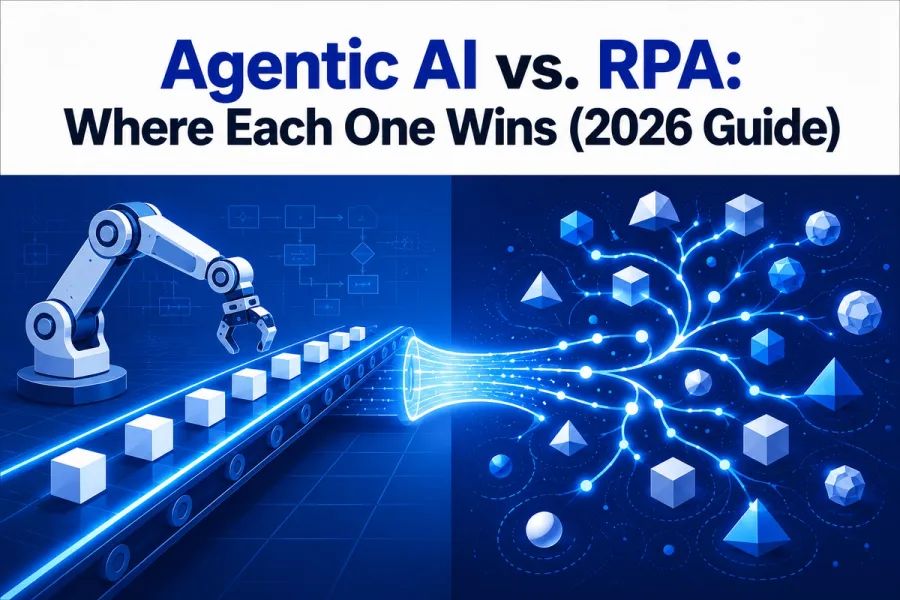
Agentic AI vs Generative AI: A Business Comparison
Dimension
Generative AI
Agentic AI
Primary Role
Content creation
Autonomous decision-making
Interaction Model
User prompts
Business goals
Level of Autonomy
Low
High
Execution Capability
No direct execution
Executes tasks
Best Use Case
Productivity and creativity
Operational efficiency
Business Impact
Incremental improvement
Transformational change
Choosing the Right AI Approach
When Generative AI Is the Right Fit
- Enhancing marketing and communication efforts
- Supporting internal teams with content and documentation
- Assisting developers and analysts
- Improving customer engagement through conversational interfaces
When Agentic AI Is the Right Fit
- Automating complex workflows across systems
- Reducing manual intervention in operations
- Managing real-time decision-making environments
- Scaling enterprise processes without proportional headcount growth
In many modern enterprises, the most effective strategy is a hybrid approach, where Generative AI provides intelligence and insights, while Agentic AI executes actions based on those insights.
Risks and Considerations
While both AI models offer strong advantages, organizations must address key challenges:
- Governance and control: Autonomous systems require robust oversight frameworks
- Security: AI agents interacting with enterprise systems must follow strict access policies
- Explainability: Decision transparency is critical for trust and compliance
- Data quality: Both AI types rely on accurate, unbiased data
A clear AI strategy and responsible implementation are essential to mitigating these risks.
The Future of Enterprise AI
The evolution from Generative AI to Agentic AI marks a fundamental shift in how businesses operate. As AI systems gain autonomy, organizations will increasingly rely on AI not just for insights, but for execution.
Enterprises that invest early in agent-based architectures, secure integrations, and governance models will be better positioned to compete in an AI-driven economy.
Choosing the Right AI Strategy for Business
Learn the key differences between Agentic AI and Generative AI, their business applications, risks, and how enterprises can choose the right AI strategy for long-term growth.